The Yijing is an unusual book. You can read it from beginning to end, but that is not how most people get acquainted with it. They open it because something is on their mind. Perhaps they have an important decision to make, or they want to understand a situation that seems to be going nowhere. They consult the book, look up the answer, and find themselves reading about dragons, crossing great rivers, marriages, military campaigns or someone climbing a city wall.
What does a city wall have to do with the question you just asked?
Well, let’s have a look.
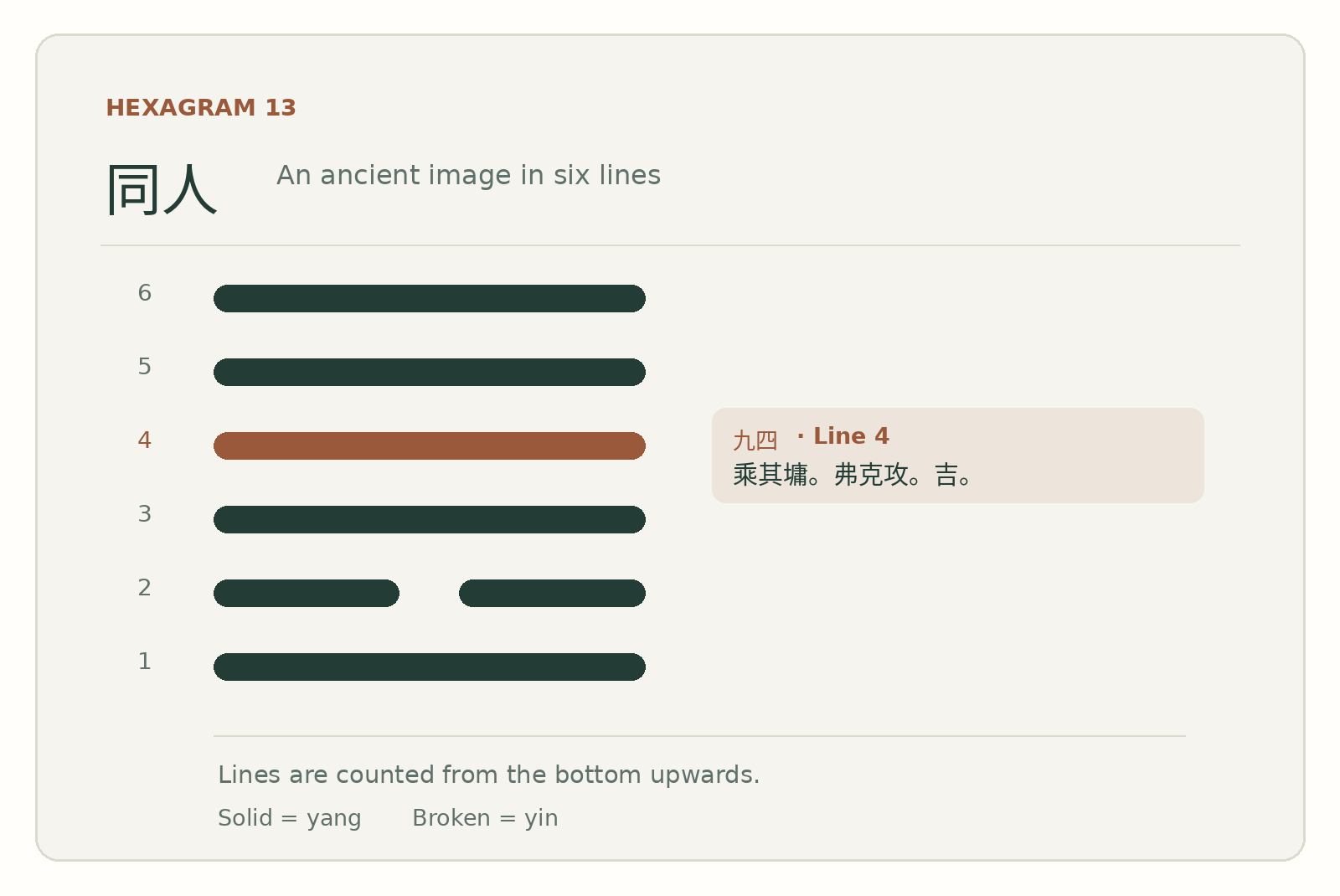
The fourth line of hexagram 13 contains the following text:
乘其墉。弗克攻。吉。
One straightforward way to read it is: He climbs onto his city wall. He cannot attack. Good fortune.
At first sight it looks like an unsuccessful military action. Someone wants to attack and cannot. Yet the line ends with good fortune. Why?
Imagine the scene. There are two opposing parties and a confrontation seems likely. One of them climbs onto a wall. From that position he cannot attack as he intended. But perhaps that is precisely why the outcome is favourable. By moving up onto the wall he has put some distance between himself and the immediate fight.
There is another possibility. Perhaps the wall is his refuge because an attack would be hopeless. Staying put is not a defeat; it may be the sensible thing to do.
Now imagine receiving this line when asking about a disagreement at work. Who is defending a position? Who is preparing to attack? Would stepping away from the confrontation help? The ancient city wall gives us something concrete to think with. That is one of the pleasures of consulting the Yijing: a scene from a world very different from ours can cast a familiar situation in a new light.
I have been exploring the Yijing since 1982, and the images still surprise me. Its short texts invite you to look more closely. Sometimes a word sends you to an early Chinese dictionary; sometimes a bronze inscription, a newly excavated manuscript or an actual record of divination suddenly makes an old passage look different. I once described working on a translation as being like a child in a toyshop: so much to see, so much to discover. I still like that description.
The book in front of us
The traditional Yijing has sixty-four chapters, one for each hexagram. A hexagram is a figure of six whole or broken lines. Beneath the figure comes its name, followed by a short statement about the hexagram as a whole and statements associated with its six individual lines. Over many centuries other texts were attached to this older core. Some discuss the images; others explore philosophy, government, morality or the nature of change.
That history gave us a book with more than one way of being read. We can study the ancient words. We can investigate the figure and the relationships within it. We can follow how a Chinese diviner in one century employed a method that was different from the method used several centuries later. We can ask what excavated texts reveal about the people who consulted the Yi before it became one of China’s best-known classics.
Two things will guide us. First, we will look at the Zhouyi 周易 itself: its language, figures, history and surviving manuscripts. Then we will turn to the people who used it and to the remarkable divination systems that grew around it. These are closely connected stories, but they are not quite the same story. The book did not remain unchanged, and neither did the methods used with it.
You need no Classical Chinese to begin. I will introduce a few characters where they make a passage more interesting and show you how to recognize what you are looking at. If you later decide to learn more Chinese, the original texts are waiting. If you would rather explore the images and read a good translation, you can already get a great deal from the book.
We shall begin with six lines. They look simple, and they are. What the Chinese did with them is another matter altogether.
Sources and further reading
- Harmen Mesker, “Tips to open up your reading (tips, not rules)”, especially the discussion of hexagram 13.4.
- Harmen Mesker, “About Tuan 彖 and Hexagram 1”, including the author’s discussion with readers about translation as an ongoing investigation.