Long before anyone could open a printed Yijing, Chinese rulers were already asking questions of an oracle. They wanted to know whether a hunt would be successful, whether rain would fall, whether illness would pass, whether an ancestor would accept an offering. Some of the answers survive in the most extraordinary way: as inscriptions cut into pieces of bone and turtle shell.
A question preserved in bone
During the late Shang period, roughly the thirteenth to eleventh centuries BCE, diviners heated prepared bones or shells until cracks appeared. The cracks were interpreted, and a record of the consultation might be inscribed alongside them. Some inscriptions include a date and the person who divined, the matter put forward, the king’s reading of the cracks and, occasionally, a note about what later happened.
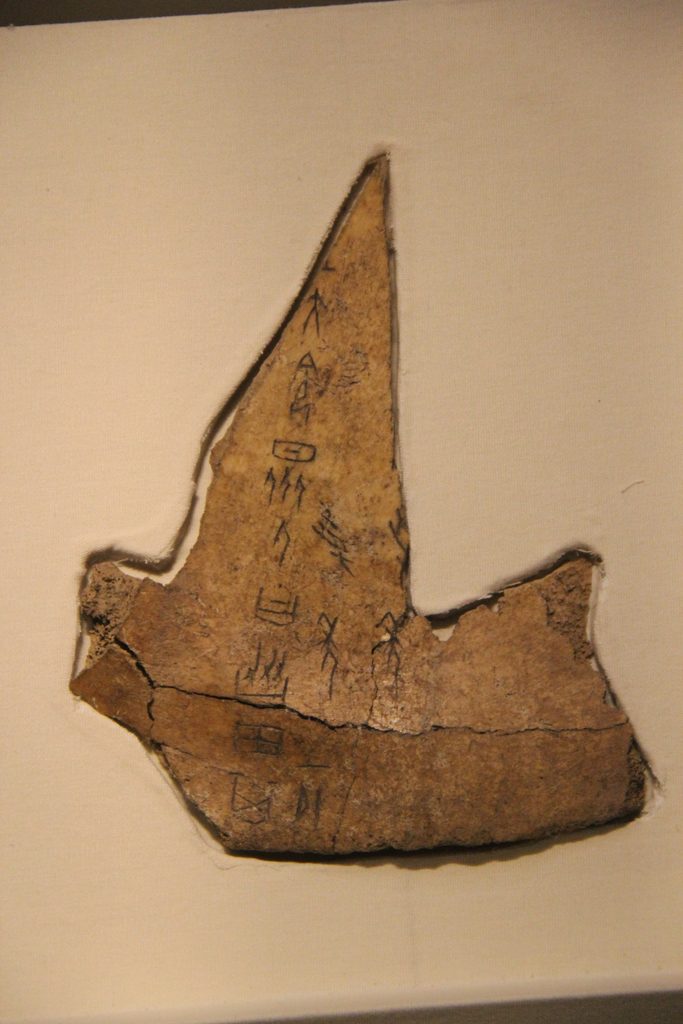
Think about what that gives us. The bones preserve not simply a religious idea but something close to the paperwork of a consultation. We can see which matters occupied people’s minds, how charges were formulated and how a court kept track of the outcomes. A Chinese character such as 貞, which appears so often in these inscriptions, is easier to appreciate when we see it doing a job in that setting.
The bone oracle and the Zhouyi are not identical systems. One reads cracks produced by heat; the other belongs to a tradition of six-line figures commonly associated with stalk divination. Their histories nevertheless cross in the language of auspicious and ominous outcomes, in the concerns of the people who used them and in the wider ritual world in which consultations took place. In my essay The Yijing as Oracle Bone’s Sidekick I explored one possible connection through the expression 亨, sacrifice and the relation between stalk and bone divination. Whether every detail of that proposal is accepted or not, it is a productive way to look beyond the familiar printed book.
Numbers on unexpected objects
Now imagine finding what appears to be a set of six numbers scratched onto pottery, bronze or a bone. At first sight they might seem like a tally. But some of these sequences look remarkably like numerical forms of the six-line figures we know from the Yi. Modern researchers often call them 數字卦 shuzi gua, “numerical gua.”
The numbers that recur include forms usually read as one, five, six, seven, eight and nine. Their distributions differ according to place, period and object. One fascinating possibility is that particular odd and even values eventually came to be represented simply by whole and broken lines. The familiar hexagram would then be one way of drawing an older numerical result. But each actual object deserves to be examined in its own setting. Six marks on a ritual object may have been produced, recorded and used differently from six marks on a writing tablet.
A celebrated bronze, the Zhongfang Ding 中方鼎, bears numerical sequences including 七八六六六六 and 八七六六六六. The temptation is to convert them immediately into whole and broken lines and announce that we have found an early Yijing hexagram. It is far more rewarding first to look at the numbers themselves. Why these values? Why two sequences? Why was somebody recording them on this vessel? Once we have considered those questions, the relation to later hexagram notation becomes a meaningful discovery rather than a guess based on visual resemblance.
How were the numbers obtained?
A six-number sequence leaves an obvious question: what procedure produced it? Researchers have tested possibilities involving counting stalks and have compared the frequency of numbers from excavated collections. The calculation matters because different procedures favour different outcomes. A convincing reconstruction should help explain the numbers that actually occur, not merely reproduce the modern distribution of sixes, sevens, eights and nines.
Constance Cook and her colleagues have brought statistical and historical questions together in work on numerical sequences. Other scholars, including Jia Lianxiang, have assembled large corpora of excavated material. Once the scattered pieces are placed alongside each other, regional patterns and variations become visible. The evidence is no longer a handful of curiosities; it is a body of material we can study.
The Qinghua 《筮法》 manuscript, which we shall meet shortly, makes this investigation especially exciting. Its numerical notation and divinatory procedures offer a concrete comparison for sequences known from other excavated objects. It shows that not every early method was simply a primitive version of the received Yijing. There were different ways to organize a consultation and read its result.
The advantage of an unfinished story
I enjoy these early finds because they force us to start with objects rather than a familiar explanation. A broken fragment, a potter’s mark, an inscription on bronze or a set of bamboo strips may preserve a little piece of the history of the Yi that later scholars never saw. New evidence sometimes confirms an old idea and sometimes invites us to arrange the pieces differently.
What the numerical finds reveal most vividly is that people were producing and recording patterned results long before our oldest complete manuscripts of the received Zhouyi. The next chapter follows some of these finds into the archaeologists’ collections. We shall look at the actual objects, and at the extraordinary range of writing that has been recovered from graves and collections of ancient manuscripts.
Sources and further reading
- Constance A. Cook, “Cracking Bones and Numbers: Solving the Enigma of Numerical Sequences on Ancient Chinese Artifacts” (research copy in the Yijing repository).
- Jia Lianxiang 賈連翔, 出土數字卦文獻緝釋 (research copy in the Yijing repository).
- Chen, “Origins of Numbers in Shifa of Tsinghua Bamboo Slip Manuscripts” (research copy in the Yijing repository).
- Harmen Mesker, The Yijing as Oracle Bone’s Sidekick.