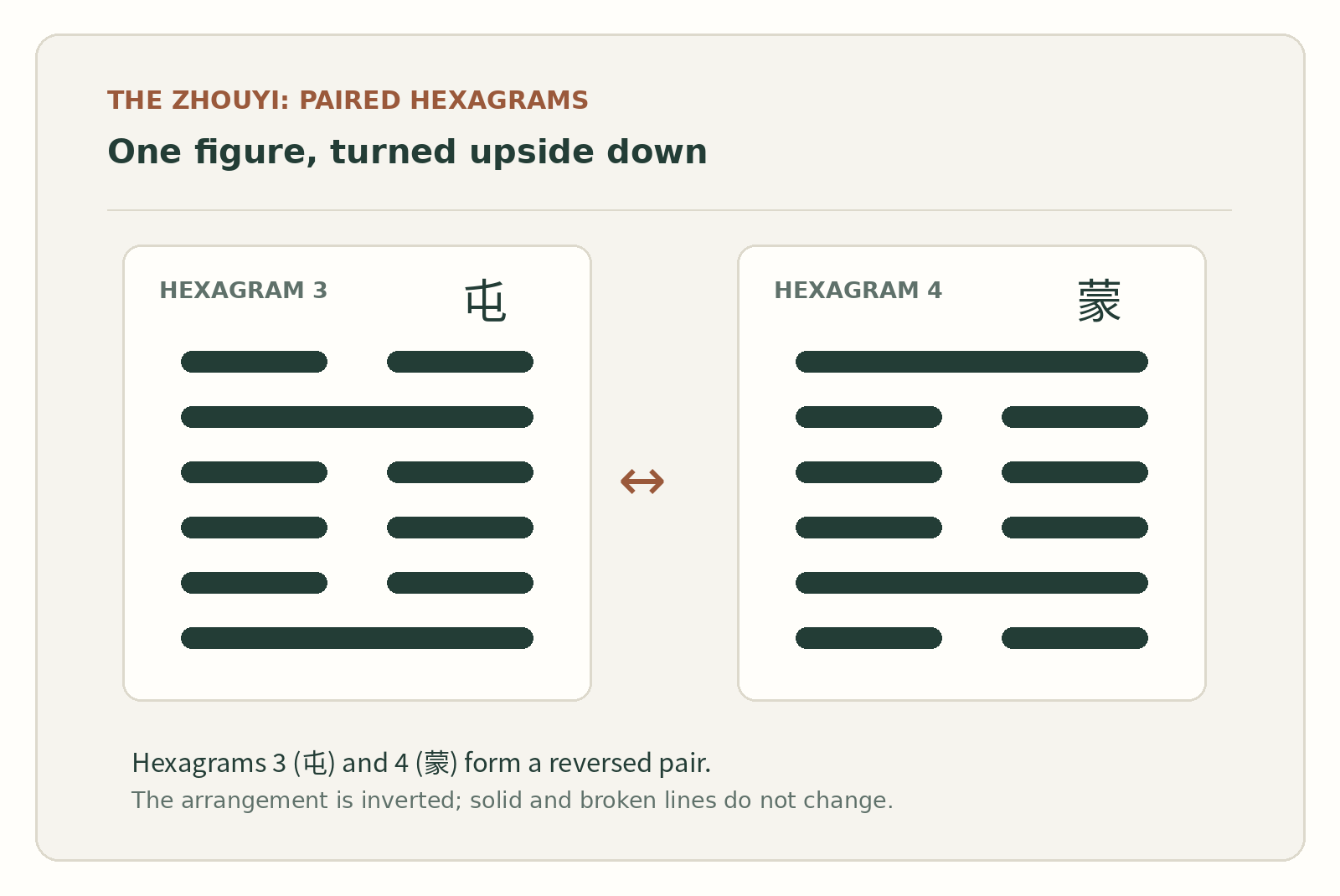
Try a small experiment. Find hexagram 3, 屯 Zhun, and then hexagram 4, 蒙 Meng. Turn the book upside down between the two figures, and you will find that the six-line arrangement of one becomes the other. That is not an accident.
Most neighbouring hexagrams in the traditional sequence are paired by turning one figure through 180 degrees. A smaller number of figures look the same after that rotation; in these cases the partner is generally made by changing whole lines to broken and broken to whole. It is one of the first patterns worth noticing when you explore the order of the sixty-four hexagrams.
A book arranged in pairs
The received sequence starts with Qian 乾 and Kun 坤, the figures made entirely of whole lines and entirely of broken lines. They form a natural contrast. Most of the following chapters are arranged in pairs such as Zhun and Meng, where reversal rather than contrast produces the partner. The sequence is divided traditionally into an upper part of thirty hexagrams and a lower part of thirty-four.
Why exactly this order? Chinese commentators have offered explanations for centuries. The Xugua 序卦, one of the Wings, tells a story in which one situation gives rise to another. It is an ingenious way of reading the sequence as an unfolding account of the world. But you can also explore the arrangement for yourself. Rotate a figure, compare its partner, and then read the two sets of statements side by side. Sometimes their themes echo one another. Sometimes the relationship is less obvious. Both outcomes are worth investigating.
The Mawangdui manuscript preserves a different order, largely grouped according to trigram structure. This is a lovely discovery because it reveals a choice that is almost invisible when we know only the received order: the sixty-four figures can be organized according to more than one principle. Their arrangement is part of the history of the book.
Words that keep returning
Open different hexagrams and certain expressions soon become familiar. 元亨利貞 appears at the beginning of hexagram 1 and in related formulations elsewhere. A great many modern translations have made the four characters into a memorable philosophical formula. Looking at the individual words, however, introduces us to the older language of offering, favourable outcomes and divination.
Take 亨 heng. It can be discussed together with 享 xiang, a character used in the context of offerings. Take 貞 zhen: on Shang oracle bones this is a familiar word in divination charges. In the Zhouyi, phrases such as 貞吉 and 貞凶 recur. I have explored these expressions in some detail in my article The Yijing as Oracle Bone’s Sidekick. The point is not that every occurrence has one hidden translation. It is that the words belong to a historical language, and the oracle becomes more interesting when we hear how that language worked.
Several other expressions are so common that you will soon recognize them: 利涉大川, “favourable to cross the great river”; 有孚, often rendered “there is trust” or “there is sincerity”; and 无咎, frequently translated “no blame.” You can read each one as a little window onto the concerns of the world that produced the text: journeys, obligations, support, risk and favourable timing.
In the case of 有孚, I once proposed an explanation based on trust and confidence, then later pursued a different reading through early forms of 孚 and 保 and through the expression 有保 in oracle-bone inscriptions. That investigation is a good example of what the old text offers. A familiar phrase becomes fresh when we follow it into another source. See the detailed article.
Sometimes the text sounds like poetry
The Zhouyi is terse but not uniformly prosaic. Some passages make use of repetition, sound patterns and rhyme. In certain places the sound can help us see where one phrase ends and the next begins. Ancient Chinese, of course, did not sound like modern Mandarin. Scholars working with reconstructed Old Chinese have tried to recover the sound relationships that an early listener might have heard.
That work connects the Zhouyi to the wider world of early verse and oral expression. It also invites a simple experiment with a translation. Read a line aloud. Notice whether the Chinese repeats a word or builds a rhythm that has vanished from the English. A translation that preserves the basic meaning may still lose the balance of the original sentence. Another translator may choose a more rhythmic English rendering and lose something of the exact word order. Comparing them is enjoyable once you know what to look for.
A structure that rewards wandering
No single pattern explains the whole book. Some hexagrams have obvious internal themes; others jump between scenes. The line statements can preserve old formulae, vivid fragments and references that made immediate sense to people living more than two thousand years ago. As the centuries passed, readers developed new ways of connecting those fragments.
This is why I encourage readers not to treat a hexagram as a bag of isolated sayings. Look at the figure, the partner hexagram, the repeated words and the sequence of images. You may discover a connection that is not obvious from the English title or a short commentary.
And once we have noticed that the very shape of the text matters, the next question practically asks itself: how do we read the Chinese words that carry all these images?
Sources and further reading
- Edward L. Shaughnessy, The Origin and Early Development of the Zhou Changes (2022), on the received text and manuscript traditions.
- Harmen Mesker, The Yijing as Oracle Bone’s Sidekick (2013).
- Harmen Mesker, “Another take on ‘you fu 有孚'” (2012, updated 2014).